 Pocket72
Finding direction without GPS
Sun, shadow stick, watch and stars
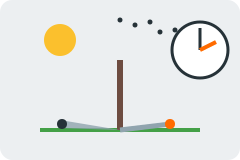
If the phone battery is empty or there is no signal, nature can still show you the direction. These methods are approximate: use them together and check with landmarks you know.
Sun
- The sun rises roughly in the east and sets roughly in the west.
- North of the Tropic of Cancer, at local solar noon (about 13:00-14:00 on summer-time clocks) the sun is to the south; in the southern hemisphere it is to the north.
Shadow stick
- Push a stick upright into flat ground and mark the tip of its shadow with a stone.
- Wait about 15 minutes and mark the new tip of the shadow.
- The line from the first to the second mark points roughly west to east.
- Stand with the first mark on your left and the second on your right: you are facing north.
Analogue watch
- Northern hemisphere: point the hour hand at the sun. South is halfway between the hour hand and 12.
- Southern hemisphere: point 12 at the sun. North is halfway between 12 and the hour hand.
- With summer time, use 1 instead of 12.
Stars at night
- Northern hemisphere: find the Big Dipper. Follow the two stars at the end of the "pan" about five times their distance: you reach the North Star, which shows north.
- Southern hemisphere: find the Southern Cross. Extend its long axis about four and a half times: the point below on the horizon is roughly south.
- Compass: hold it flat, away from metal, phones and magnets; the needle shows magnetic north.
Common mistakes
- Trusting moss on trees: it grows on many sides.
- Changing direction often instead of walking towards a landmark.
Checklist
- Paper map of your area
- Baseplate compass
- Analogue watch
- Notebook and pencil
Sources
Pocket72 does not replace the authorities or the emergency number. In danger, call 112 (or your local number) and follow official instructions. No medical advice, no medicine doses and no wild plants: take a first-aid course.